Author Archive

#UPR2025 focus on policing

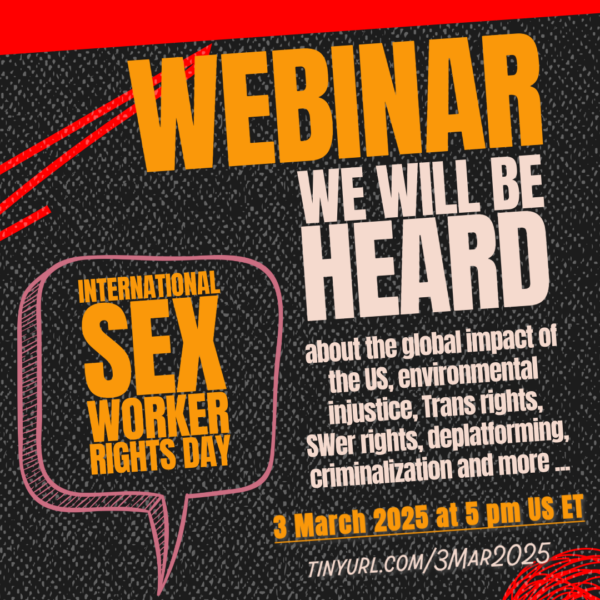
For the last 18 months BPPP and other coalition members have been documenting the human rights impact of policing on our communities and organizing to change these circumstances. This material will be presented to the United Nations in April 2025 and provide organizing impetus throughout this year. Today March 3rd — International Sex Worker Rights Day — some of the multi-person research collective and artists illustrating the issues hosted a webinar. Two of the topics we presented today considered policing and criminalization.  The following is a summary of the presentations.

Sex workers are everywhere. We live and work in every social strata in the United States of America and represent every social group. Just like any other human being. We are here. We are seeking to enjoy all our human rights and to live our lives. We are in solidarity with oppressed communities worldwide.

From our research and our lives we know that criminalization is an overarching and intersecting issue that impacts all issue areas in this report. 

Street-based or outdoor workers, transgender or gender expansive people, BIPOC, migrants, youth, and incarcerated sex workers, consistently bear a particularly heavy burden of law enforcement abuse and harassment, institutional discrimination, and violence. The current U.S. administration is hostile to human rights, violating in particular the rights of migrants and transgender people.

Criminalization leads to policing, which leads to arrest and incarceration. Involvement with the court system in the US is extremely harmful to low income people and all other groups of folks who don’t have access to power and privilege. As advocates we have seen court rooms dedicated to processing arrests for prostitution that are set up for all to plead guilty. The risks of pleading not guilty are enormous and lead to ongoing police harassment, legal threats and enormous monetary costs. Criminalization of our lives is insidious, stigmatizing us and forcing us to the margins. Current forms of criminalization impinge on our right to organize and digital assembly

This is why global recognition of the rights of sex workers is important to note and affirm. And the hope of Recommendation 86. During the 9th Round of the Universal Periodic Review, the U.S. accepted Recommendation 86 from Uruguay to “undertake awareness-raising campaigns for combating stereotypes and violence against gays, lesbians, bisexuals and [transgender people], and ensure access to public services paying attention to the special vulnerability of [sex] workers to violence and human rights abuses.”

Policing (including defunding the police) 

Globally and in the United States, the number one concern for sex workers is policing. 

In human rights terms police are considered “State agents” and governments are responsible for their actions and impact on our rights. Other state agents are ICE and border guards. 

We should be protected from police violence and abuse and torture while detained. However, being treated “well” by law enforcement/ICE is not enough. 

What we want is an end to the criminalization and policing of our lives. We consider every arrest for sex work a rights violation. In gathering information about activities to change patterns of policing, we heard from our communities that “we have always questioned police motives.” The public outcry about policing occurring in 2020 and onwards via Black Lives Matter, has opened new strategies for sex workers and trans folks and new engagement.

What have our experiences been in the last 4 to 5 years from the survey? 18% of folks surveyed said that they had been detained by the police. Folks shared that they had been caught up or arrested in stings, by undercover, for walking down the street and while advocating for rights of others. Some were detained for hours/days and some arrests led to years in prison. 

12% of folks said that they had been forced to have sexual contact with police in order to avoid arrest etc. 10 people gave detailed accounts of these situations. We also received reports of security guards exhibiting the same abuses.

Run ins with the police leads to incarceration (25% said they had been incarcerated for issues relating to sex work, but also for being involved in protests, for defending themselves, for protecting other sex workers,  for outstanding warrants and the like). 

Substance users have specific issues. We have a great report from Philly that we will be citing

32% (about one third) of folks said that they had been part of the outpouring of campaigns in the United States to change or end policing since 2020/the beginning of the COVID-19 pandemic. Folks were inspired to challenge the ways in which policing is carried out and in some cases to defund the police.

In May 2020 George Floyd was killed by the police and what he said with his dying breaths was the whole pandemic and its intersections – I can’t breathe. I see pandemics of COVID, policing, anti Black violence, and anti-sex worker and anti-trans sentiments. I believe now that more people see that these are all linked. I am heartened that sex workers are being included as essential in organizing to end policing as we know it. I was also very pleased to see donations of actual money coming in for Black led organizations.
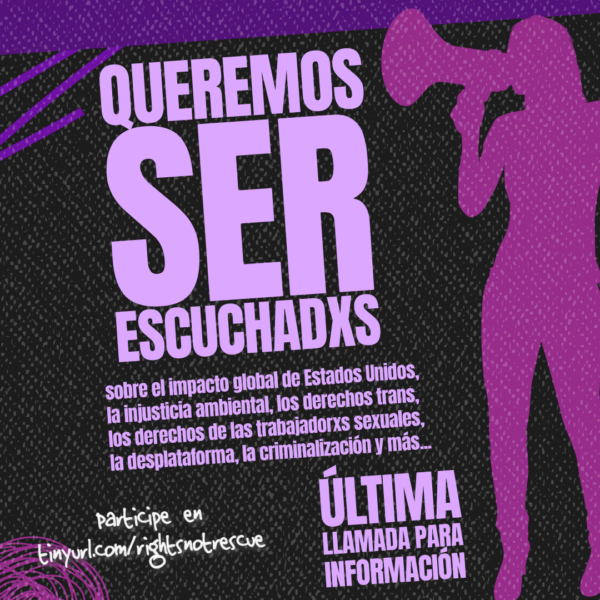
Envía información para el informe de derechos (¡todavía estás a tiempo!)

Nuestra recopilación de información se extendió por algunas semanas, porque las Naciones Unidas actualizaron sus plazos. 160 personas y organizaciones completaron la encuesta. Esta es una de las muchas formas en que podemos aprender sobre los desafíos y los éxitos que hemos experimentado colectivamente en los últimos cinco años. Mientras escribimos esto, nuestros corazones están con toda nuestra comunidad afectada por los incendios en California y con todas las demás crisis diarias que enfrentan nuestras comunidades en los Estados Unidos, incluidas la vigilancia policial, los arrestos y la injusticia ambiental y económica.

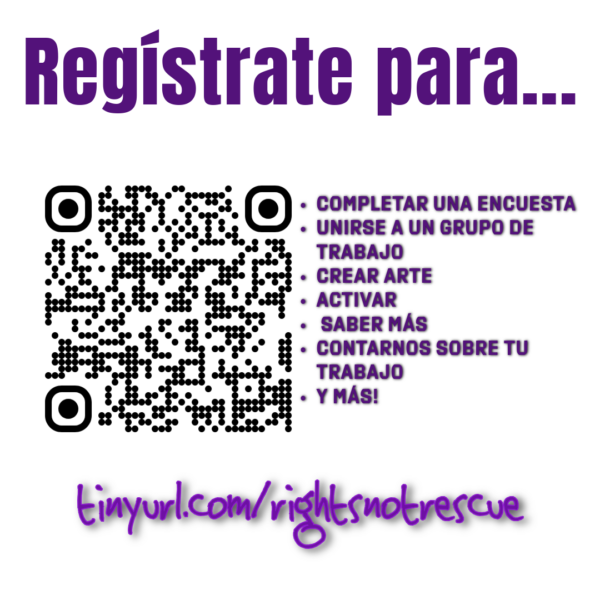
¿Cómo puedes comunicarte con nosotros? Completa el formulario de expresión de interés para obtener un enlace de la encuesta o envíanos un correo electrónico directamente a bestpracticespolicyproject [at] gmail.com y rightsnotrescue@protonmail.com antes del 17 de enero de 2025.

¿Qué estamos aprendiendo hasta ahora? Beyonce Karungi está coordinando el desarrollo de nuestro informe preliminar y trabajando con un equipo de miembros de la comunidad de nuestra Coalición para recopilar la información que estamos recibiendo. Beyonce ha proporcionado los siguientes temas generales hasta el momento.

Criminalización (la causa principal de las violaciones de derechos)

La policia (incluido el desfinanciamiento de la policía)

Inmigración

Derechos trans, incluida la intersección de cuestiones de trabajo sexual y leyes antitrans

Los derechos de las trabajadoras sexuales callejeras

Cuestiones de VIH/SIDA y migración

Injusticia económica (incluida la exclusión de plataformas y la pérdida de acceso)

Los efectos del cambio climático en nuestro trabajo y nuestras vidas

COVID-19

Violencia

Los derechos de los usuarios de sustancias

El impacto global de las políticas estadounidenses

Share materials and issues for the rights report (still time!)

Our information collection was extended for a few weeks, because the United Nations updated their deadlines. 160 folks and organizations have filled out the survey. This is one of many ways we can learn about the challenges and successes we have collectively experienced in the past five years. As we write this our hearts go out to all of our community being impacted by the fires in California, and to all the other daily crises our communities face across the United States including policing, arrest, and environmental and economic injustice.

How can you get back to us? Fill in the expression of interest form to get a survey link or email us directly at bestpracticespolicyproject [at] gmail.com and rightsnotrescue@protonmail.com by January 17, 2025.

What are we learning so far? Beyonce Karungi is coordinating the development of our draft report and working with a team of community members from our Coalition to collate the information we are receiving. Beyonce has provided the following general themes so far.

Criminalization (the root cause of rights violations)

Policing (including defunding police)

Immigration 

Trans rights including intersection of sex work issues anti-trans laws 

The rights of street sex workers

HIV/AIDS issues and migration 

 Economic injustice (including de-platforming and loss of access)

Climate change’ s effects on our work and lives

COVID-19

Violence

The rights of substance users

The global impact of the US


December 17 – Breaking the silence about violence

Today 4 pm US ET – we are acknowledging December 17, 2024 with a webinar entitled Silence, Violence, and Sex Workers Rights, a roundtable discussion put together and moderated by New Jersey Red Umbrella Alliance and supported by BPPP. Come and learn about how we are documenting the rights violations experienced by sex workers and trans folks, how to get involved and how this will end the silence.
Register here —> https://us02web.zoom.us/webinar/register/WN_Kw0wSHGiSk6n2gYwA_Swsw

We will be speaking about our research into rights violations as we prepare to hold the US accountable at the United Nations in 2025. Interested in joining the research project? There are many options for participation including filling out a survey, having a conversation, filing a report of a violation, being on a mailing list, joining a working group and/or applying to join our artists cohort. Express interest by filling out this form https://form.jotform.com/rightsnotrescue/join-us

More about today’s moderator – Session moderator N’jaila Rhee is the executive director of NJRUA. N’Jaila is a key member of the coalition preparing a UN report on human violations experienced by sex workers in the US and the policies affecting sex workers worldwide wide. N’Jaila led an enthusiastic team to EXXXOTICA this year providing direct support, harm reduction and information, including two workshops on human rights and arts.

N’Jaila Rhee, ED of NJRUA
Beyonce Karungi

Featuring panelist Beyonce Karungi – Beyonce began her activism with key populations in 2009 and is also involved in efforts to stop violence towards women and girls, to promote sex and sexuality education for youth, and to increase young people’s access to friendly SRHR services across Uganda. At the global level, Beyonce worked with the International Reference Group on Trans Women and HIV, UNDP, UNFPA, UNAIDS, PEPFAR, the Global Fund, and USAID to develop the TRANSIT. Beyonce is currently leading the drafting process of the upcoming UN shadow report on the state of sex worker rights and trans rights in the US and the impact of US policies worldwide.

Jenna Rollins will do a reading and be part of the moderated discussion today on how we are documenting rights violations and ending the silence about violence against sex workers. Sign up here – https://givebutter.com/ivjGxl

Jenna Torres