Category: Policy Updates

An Open Letter to USCHA on Exclusion, Safety, & Accountability

September 3, 2025

To the organizers of the United States Conference of HIV/AIDS (USCHA), on behalf of the Sex Workers Rights Coalition,

USCHA is the largest annual HIV/AIDS conference in the United States. It positions itself as “a platform for frontline workers to enhance your capacity building, skill development, and idea exchange” and a “growing table for our movement that convenes the HIV community, workforce, government, policymakers, and industry to end the HIV epidemic.” Unfortunately, its current practices directly undercut that mission.

We write with deep concern regarding ongoing patterns of exclusion, inadequate safety planning, and failure to meaningfully support impacted marginalized communities at USCHA. As participants, advocates, and community members directly impacted by the HIV/AIDS crisis, we urge USCHA and NMAC to take accountability for harmful practices and to commit to substantive change. 

Honoring the Legacy, Not Erasing It

The HIV/AIDS movement was built by the very communities that USCHA’s practices now exclude – BIPOC, sex workers, trans people, migrants, people who use drugs, and people facing economic injustice. From the 1980s to today’s harm reduction networks, our communities created the strategies that forced institutions to act. ACT UP (AIDS Coalition to Unleash Power), a grassroots coalition of people living with HIV/AIDS and their allies – many of them queer, trans, economically disprivileged, migrants, sex workers, and people who use drugs – confronted pharmaceutical companies, government agencies, the Catholic Church, and police violence. They demanded not only access to treatment but recognition of the rights and humanity of our communities. This movement, including USCHA’s platform, was built on the backs of those whose survival was won by refusing to wait for institutions to care or catch up. 

To exclude these same communities now through financial and structural barriers is not just oversight – it is a betrayal that erases the legacy USCHA claims to honor, and reduces a radical movement of resistance into something sanitized and institutionally palatable.  


Complicity in Policing Dangerously Framed as “Know Your Rights” Guidance

The recently published Know Your Rights 2025 document produced by USCHA for conference attendees at increased risk of state and police violence demonstrates the dangerous consequences of excluding our communities from meaningful participation and leadership.

By convening in Washington D.C. – a city that is actively undergoing forced militarized occupation under openly fascist leadership – USCHA invited migrants, non-citizens, and other criminalized people into an actively repressive environment without providing meaningful safety planning. The Know Your Rights 2025 (KYR) document directly discourages and contradicts well-known and practiced abolitionist survival strategies and falsely equates compliance with safety, leaving those most vulnerable exposed to the very systems of violence the conference claims to resist. This so-called guidance places the burden of safety and protection entirely on those most at risk by encouraging alignment with state-violence: 

  1. Advising attendees not to “resist” disregards the realities of state violence, reinforces compliance with police, and dismisses the powerful legacy of resistance strategies that have kept criminalized communities alive. 
  2. Suggesting people carry ID at all times, collect badge numbers, and file complaints later assumes privilege and safety many do not have – and directly disregards the life threatening impact that any encounter with police have on criminalized individuals and communities.
  3. Insisting that “you cannot fight police misconduct on the street” is a violent erasure of the necessity of street-based response to state oppression: from ACT UP chaining themselves to FDA doors and storming St Patrick’s Cathedral during the AIDS crisis, to trans, unhoused, and sex worker communities resisting raids, to present-day protest and de-arrest tactics that protect people from state-sponsored genocide across the globe. Resistance to state violence has never been optional – it is a necessity for the survival of our communities.

To tell attendees that quiet compliance is the best and safest strategy is not only dishonest and dangerous – it is complicity in state violence. This so-called “guidance” betrays the radical abolitionist survival strategies that have historically kept our people alive: street protest, mutual defense, de-arrest, and collective resistance. 

Without these tactics, there would be no USCHA, no HIV/AIDS movement, and no space for our voices at all. Erasing this legacy while promoting advice framed as “safety / rights”  is not only misguided, it is antithetical to the very work USCHA claims to advance.


Structural Barriers and Rejection of Community-Led Panels 

In 2023, sex worker-led groups successfully presented well-attended and highly valued panels at USCHA, including one titled “Blocked and Criminalized: HIV/AIDS, Anti-Trans Laws, and Sex Worker Rights”, that provided stakeholders with concrete tools to reduce stigma and improve health outcomes, and even motivated conference organizers to state their intention to create a dedicated sex work track for future conferences.

Yet instead of building on that commitment, USCHA moved to exclude us.

In 2024, four grassroots organizations submitted panels that were accepted, but were not given the necessary tangible support to enable these groups to attend and present. Each panel, comprised of multiple speakers, was offered only one free speaker registration. Without equitable support, those speakers could not attend, and those sessions ultimately did not take place. Attempts by these organizers to request accommodation from conference coordinators went unanswered. 

In 2025, all panels submitted by those same groups were rejected outright. 

This pattern highlights broader systemic barriers:

  • Economic Disenfranchisement: By requiring presenters – especially those lacking institutional funding or affiliation – to self-fund registrations, travel, and accommodations, USCHA effectively bars low-income and criminalized communities from meaningfully participating in the conference.
  • Selective Representation: Institutions with resources are privileged, while those with lived experience are excluded and silenced. This distorts who shapes policy and practice, and undermines the depth and relevance of the movement. Marginalized communities enrich movement spaces through our perspectives, solidarity, and everyday participation – not only when we formally present. Yet USCHA’s lack of financial or institutional support, whether for speakers or general attendees, means those most impacted are often unable to participate at all. 
  • Erasure of Resistance Histories: Sanitizing HIV/AIDS activism by sidelining criminalized communities severs USCHA from the legacy of ACT UP and other movements that centered radical care, mutual aid, and resistance to policing and state violence. The very people who built the foundations of HIV/AIDS activism are being pushed out of spaces that now falsely claim to carry our legacy.

These harms are compounded by USCHA’s pattern of limiting support to sex worker-led and community-driven participation, even when we have meaningfully demonstrated the value of our contributions.


Exclusion of Sex Workers and Trans Communities is a Human Rights Violation 

The ongoing exclusion of sex workers and criminalized communities and diminished trans, BIPOC, and migrant representation within so-called movement spaces is not simply an omission or accident – it is a violation of human rights. Though our communities remain disproportionately impacted by the HIV/AIDS crisis, USCHA’s practices disregard the profound harm caused by our exclusion in a space that profoundly influences national policy and healthcare practices.

The absence of criminalized, gender-diverse, migrant, and marginalized voices reflects ongoing stigma that ultimately weakens the national response to the HIV/AIDS crisis. This exclusion shifts the burden onto our most disenfranchised communities to constantly prove our relevance to movements we created, not only to secure participation, but to ensure survival. 

The principle of “Rights, Not Rescue” must guide HIV/AIDS activism. This phrase, coined within sex worker-led movements, is a powerful call-to-action that pushes back against paternalistic “rescue” frameworks that treat survivors of violence as victims to be saved rather than leaders with agency, expertise, and inherent human rights. Rescue models have historically justified criminalization and exclusion in the name of protection, deepening and compounding the harms our communities face.

A truly human rights-based approach, by contrast, demands that our communities and lived experiences be resourced, centered, and heard on our own terms. The only effective way to uplift people who have historically been disenfranchised is to work with us directly and invest in our leadership – not to speak for us.


Our Demands

To restore integrity and align with the communities most impacted by HIV/AIDS, we call on USCHA to: 

  1. Guarantee equitable tangible support for community-led panels: this includes providing full registration waivers and meaningful travel and accommodation for all presenters who cannot otherwise attend.
  2. Institutionalize sex worker, trans, and BIPOC leadership: commit to dedicated presentation tracks, decision-making roles, and advisory structures that are appropriately compensated to ensure our communities are not only included, but truly centered. 
  3. Retract and revise the current Know Your Rights document: Redraft this document in consultation with impacted criminalized communities and legal advocacy groups, ensuring guidance is trauma-informed, realistic, centered in harm reduction, and in anti-criminalization and abolitionist principles that honor the legacy of resistance to fascism and policing. 
  4. Develop a safety plan for conference participants that acknowledges active risks and engages a shared sense of community responsibility: mobilize privileged attendees not just as bystanders but as accountable protectors by providing training in intervention tactics, legal and financial resource-sharing, and collective abolitionist strategies like protest defense, de-arrest, and jail support skills. Safety at USCHA cannot be left to individual survival; it must be built through a shared sense of accountability to actively protect those most vulnerable to policing and state-sponsored violence. 
  5. Implement true accountability and transparency: publish clear data on accepted / rejected sessions, scholarship decisions, and community representation at each conference, and honor commitments made by conference organizers to center sex-worker led tracks at future conferences.

It’s not too late for USCHA to prioritize solidarity.

As the Sex Workers Rights Coalition, we invite conference organizers to honor their stated commitments by ensuring sex workers, trans people, migrants, and other criminalized communities are not just invited, but centered, in movement spaces. 

To host a national conference that systematically excludes the very communities who built this movement represents a stark break from the legacy of resistance that USCHA claims to honor. Without addressing these concerns, USCHA is presenting a polished and institutionally palatable version of the HIV/AIDS crisis while sidelining the criminalized communities whose organizing historically shaped the earliest and most effective responses to the epidemic. This is not only revisionist – it is a betrayal of our history and our communities.

We believe USCHA can and should serve as a space of solidarity, safety, and genuine community leadership. To do so, it must take accountability for the harm caused and implement changes that reflect the realities of those most impacted by HIV/AIDS who are central to the resistance and advocacy that made this movement possible.

We look forward to your concrete commitments to change, and invite other coalitions, organizations, and individuals – whether you are attending USCHA this year or not – to join us in calling on USCHA to be in true solidarity with all communities impacted by HIV/AIDS. 

In solidarity,

Penelope Saunders & Erika Smith | Executive Directors | Best Practices Policy Project

Cristine Sardina | Director |  Desiree Alliance

N’jaila Rhee | Executive Director | New Jersey Red Umbrella Alliance

Noor Z.K. | Director | Sex Workers Educating & Empowering Texans (SWEET)

And the Sex Workers Rights Coalition 

Add your name or organization to sign-on in solidarity with our statement: 
An update on Uganda

In our last post about the Ugandan Anti-Homosexuality Act, we talked about the implications of the draconian law that prescribed death for gay Ugandans and imprisonment for their allies. A year later, the act was upheld by Uganda’s highest court which admits that some provisions violate the right to health and privacy. Effects on the Ugandan LGBTQ+ population have been immediate and devastating. Trans women living in Uganda report inability to access basic healthcare as services like transportation or access to a medical provider are no longer guaranteed. Trans sex workers are targeted to the point of being unable to work.  Organizations serving queer Ugandans have been forced to shutter under the pressures of state and local harassment and queer individuals are being outed in the media under accusations of promoting homosexuality and spreading HIV. Incidentally, the Anti-Homosexuality Act makes a provision for the death penalty in the case of aggravated homosexuality which prohibits intercourse with persons of the same sex when one is living with HIV. The criminalization of HIV has been Ugandan policy since at least 2014  and has been proven detrimental to public health and individual wellbeing. The targeted criminalization of queer and Trans persons with HIV will have ripple effects throughout Ugandan society. 

Ugandan Queer and Trans sex workers face insurmountable barriers to work and survival. Public transportation is no longer an option for many as the law has increased the levels of hostility they face daily. As a result, Queer and Trans Ugandans are going without medical and support services usually provided by NGOs. This reality is exacerbated by the closure of NGO run support resources due to the risk of prosecution for being allied with the LGBTQ+ community. 

We are calling on our allies. Do not turn away from the atrocities against Trans Ugandans. The assault on queer and Trans rights means that these communities are unable to meet their needs through work and are unable to access NGO support. The Best Practices Policy Project implores all allies to familiarize ourselves with the ongoing crisis for queer and Trans Ugandans. Call on your elected leaders to speak out and donate to organizations that are able to support queer and Trans persons on the ground. 

Position Paper on Sex Work (for International Whores Day)

BPPPers Zee Xaymaca and Jenna Torres have developed a living document on the rights of sex workers that we are releasing just in time for International Whores Day (June 2, 2024) and in advance of international UN meetings where sex work will be affirmed. Co-directors Penelope Saunders and Erika Smith contributed to the document as well. The document can be accessed as a Google Doc. And below as the full report text. Zee has also created some images for social media. Share them widely.

BPPP POSITION PAPER ON SEX WORKER RIGHTS

(as of June 2, 2024)

A DYNAMIC DOCUMENT UPDATED REGULARLY

Sex work, the exchange of sexual services for material benefit, is a lasting feature of our society and economy. Sex work is an umbrella term that is intended to be expansive to include various types of legal, stigmatized, and/or criminalized forms of work. This term is used to advocate for and defend rights globally. 

Sex workers, like all who sell their labor, choose to engage in this exchange for a myriad of reasons that must be respected if sex workers are to be supported by public policy. It is important to center that achieving sex worker rights is not a linear process, but a long-term engagement with all communities of sex workers, prioritizing the communities directly impacted by policing, repression, and stigma. There is no “one-size-fits-all” policy solution other than the call for full decriminalization of the sex trades and the ending of the criminalization of our lives.

As sex workers and activists with decades of experience advocating for sex workers’ rights, we have created a body of work that outlines our position on sex work as an element of society. We have documented the ways in which governments, states, municipalities, non-governmental organizations, and global entities use policy to try, and fail, to repress our voices. The following outlines some of the consequences of erasure for sex workers, our resistance to this organized violence, and our policy recommendations that are truly sex worker-inclusive. 

Anti-Racism, Anti-Oppression

The criminalization of sex work is weaponized by government entities against Black, Indigenous, and People of Color (BIPOC) folks, immigrants, trans and gender non-binary people, women of color, and folks who are parents, poor, disabled, unhoused, and/or drug users. 

All aspects of collective organizing for the rights of sex workers must be committed to ending this racism and other forms of oppression such as classism, ableism, xenophobia, transphobia, whorephobia, and misogyny. The process of developing policy and advocacy positions in any sector and social movement must challenge two issues: first, that the spokespersons whose voices are amplified are usually white, cis, and from the global North; second, that measures proposed prioritize white, cis-hetero persons’ needs over addressing the complex structures that make these measures insufficient for queer BIPOC folks and other oppressed groups listed above. We are in solidarity globally with policy approaches, research, activism, art, and publications produced by communities in the global South directly impacted by policing, repression, and stigma.

The only path to equitable outcomes is policy engineered by the folks directly impacted by policing, arrest and the injustice systems, and implementation led by us. 

This stance goes beyond the decriminalization of sex work and calls for the intentional ending of the criminalization of our existence as BIPOC queer and Trans sex workers — meaning, the removal of legal and social barriers to life-affirming resources.

Economics

Sex work is resistance to economic disenfranchisement. For many who have been excluded from formal employment markets, sex work is a viable way to meet our needs. Policies that criminalize sex work and our lives seek to condemn sex workers to continued economic precarity. Money is a means, and often the only means under capitalism, of attaining security and survival. Engaging in compensated sexual labor is a reclamation of value for work that is devalued by capitalism. Our labor is a crucial aspect of the United States and global economies. We support our communities with our incomes and continue to build stability for ourselves as a response to state-sanctioned economic violence such as laws that make it impossible for sex workers to operate safely, i.e. loitering laws, and solicitation statutes. We also resist policies that prevent sex workers from accessing banking and financial services, and we support alternatives developed by our communities to access such services and provide mutual aid.

Agency

Sex work decriminalization is the ending of all laws and policies restricting sex work. This combined with the ending of the overall criminalization and policing of sex workers’ lives removes barriers to organizing against exploitative employment practices and violence, thereby securing the autonomy of all who engage in sex work. Ending criminalization and policing is key to sex workers’ on-the-job safety. If we are confident that the state will not persecute us for our labor, then we are more likely to avail ourselves of legal remedies when our rights come under threat. Decriminalization and ending the criminalization of our lives acknowledge that we are rational beings and protect our rights. 

Security 

Criminalization is a threat to security. Online advertising platforms, for example, allow sex workers worldwide to find and pre-screen customers/clients online, allowing many to screen in a way they find secure. These safety measures are being destroyed by the criminalization of online assembly and speech. Sex workers who do not depend on or have access to the internet have also established screening and safety protocols, however, the threat of police harassment undermines these practices leading to rushed negotiations and less time to assess danger. Police also use loitering laws to harass Trans and Gender Non-Binary persons regardless of their sex worker status. The threat of arrest does not reduce “demand” but rather creates danger for our communities engaging in sex work. 

Public health

Under criminalization, carrying safer sex items can be used as evidence of engaging in sex work. The criminalization of carrying condoms and lubricants adds a public health component to anti-sex work laws and policies. Condoms are an effective and accessible way to prevent the transmission of sexually transmitted infections. Arresting people for carrying them increases the likelihood that workers will have to choose between unprotected engagements and being able to meet their needs. Sex workers have been at the forefront of global HIV advocacy despite the hostility we often face in these spaces. Trans people have long advocated for bodily autonomy and decriminalization of sex work as a public health measure. Transgender and gender-expansive persons are more likely to face barriers to accessing preventative healthcare as well as ongoing treatment for chronic illness due to gender discrimination. Reproductive rights come under threat when sex work is criminalized as persons who engage in the sex trades often face stigma when they reveal their vocation in seeking access to care and information that promote reproductive autonomy. This may look like engaging with hostile or ignorant medical personnel or being denied healthcare altogether. This reality means decriminalization and destigmatization of “paraphernalia” (including other harm reduction items like syringes and fentanyl testing strips deemed tools of illicit activities) in addition to decriminalizing the sex trade is a crucial step in protecting the health of gender-expansive populations. 

Harm Reduction

Sex work can be the nexus of several forms of marginalization. However, it is not marginalization in itself, but a mode of resistance to economic and social erasure. We are excluded from mainstream narratives of social and economic empowerment. So we create it for ourselves, sometimes confronting and managing risks, but this is less perilous than continued engagement with state apparatuses. Sex workers who have been criminalized are ineligible for work-related social services like welfare or state-sponsored healthcare. We create these resource networks for ourselves through mutual aid and cross-movement advocacy. Sex workers are intimately acquainted with the implications of disability, climate, reproductive justice, prison abolition, and other movements that advocate for broader rights recognition and resource access. 

Climate Justice and Migration

As climate catastrophe causes displacement and change, there will inevitably be an increase in the number of people whose livelihoods are suddenly disrupted. This is expected to create greater reliance on informal work sectors, including sex work, as more people must find quick and accessible ways to meet their needs. In light of this ongoing disruption, state social service structures must avail themselves to more people, including refugees and long-term immigrants. Decriminalization of sex work removes a major access barrier for migrants seeking assistance by protecting migrants regardless of their status as a sex worker. 

Conclusions

Sex worker voices matter. Our voices are essential in achieving rights for ourselves, the collective liberation of other workers in other sectors, and achieving change via other social movements. We once said, “Nothing about us without us.” Now we say: Without us, nothing can truly change. Our rights are not something that can be thought about later. Our rights and our voices are foundational. 

When we remove the barriers of criminalization, we have more agency and autonomy to make choices and seek support in navigating the realities of our work without the fear of prosecution or other systemic harms. The option to engage in sex work is not the problem. The true issue is the environment created when all the intersecting circumstances such as social, systematic, and economic inequality show up as barriers and their impacts on our community who are just trying to provide for themselves and others. As people who often sit at the margins of many intersecting identities and how the world is shaped around us to hold our experiences, we are left to battle both domestic and global impacts. We have to navigate the constantly changing landscape because of the negligence we face by being underrepresented in larger conversations. Policies that have neglected our autonomy, security, health, safety, stability, and climate. 

The recommendations that we collectively want are the recommendations that give folks the most autonomy. These are the complete removal of policies that prohibit the sex trades and the ending of the daily criminalization of our lives. These recommendations allow sex workers to freely create resources that keep everyone safe and supported. Resources such as harm reduction tools to engage in safer sex, access to culturally competent healthcare, the ability to create online platforms to screen clients or continue to use platforms without fear of shutdowns, and freedom to engage in our community for safety. The sex trade prohibitions are largely created out of fear, moralizing, and the general misunderstanding of how and why people engage in sex work. People in the sex trades want the ability to be safe and supported just as much as any other labor job. We are asking for nothing more than what is already highlighted as the global standard by including sex workers and our livelihood in the United Nations Sustainable Development Goals. Specifically, we refer to goal number 8 that pertains to the idea of decent work and economic growth. 

We have consistently demonstrated our presence in public health, labor rights, reproductive justice, and human rights as advocates for a non-exploitative labor environment. Sex workers are often the first line of defense when people are experiencing harm and we are the ones who help folks navigate pathways to obtain the right resources. We deserve safe working environments to create self-determination in ways that otherwise may not be possible. Our access and insight are invaluable. 

Authors: Zee Xaymaca and Jenna Torres, with Penelope Saunders and Erika Smith

Decoding the “Equality Model”

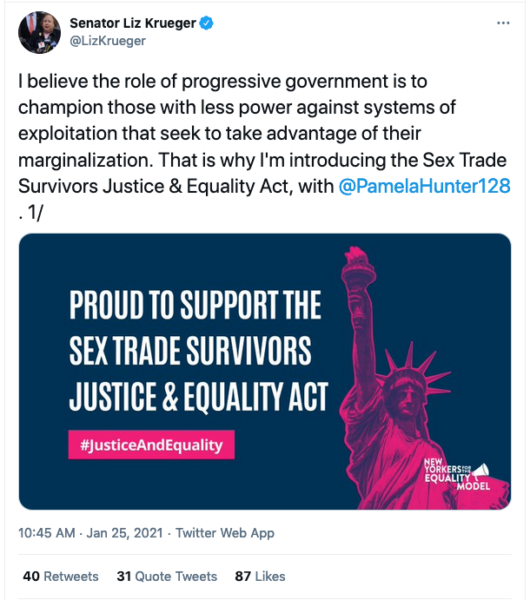
The following is a work in progress as we quickly examine the roots of a bill, the Sex Trade Survivors Justice & Equality Act, that was was introduced in the New York state Senate by New York Senator Liz Krueger and Assemblywoman Pamela Hunter on Monday March 25, 2021. The purpose of the bill is to criminalize people associated with sex work and provide additional resources for policing, a form of criminalization that sometimes is referred to as the “Nordic Model.” The text of the bill is not yet publicly available leading to a moment in advocacy when we find ourselves responding to an issue without having the text before us. An important approach at BPPP, an approach that is shared by many of our coalition members in this case specifically the BSWC, is to review original source to decode exactly what is happening with new legislation, “terms of service” and other documents. Often when we dig deeper we find that the outcomes are far worse than we ever could have gleaned from reading press reports. We encourage everyone to follow the BSWC and sign on to materials the BSWC is developing.

Since the text of the introduced bill, the Sex Trade Survivors Justice & Equality Act,  is not available we reviewed Senator Liz Krueger’s tweets to find out more. Her tweets led us to the website of the New Yorkers for the Equality Model, illuminating the thinking behind the bill and the sleight of hand brought to bear in efforts to criminalize sex work, sex workers and to bolster policing at almost any cost to low income communities, immigrants and people of color.

The “bill summary” at the site hijacks the language of many years of advocacy to end the criminalization of sex workers and trans people’s lives in New York, without adhering to any of the policies that would actually create this change. The resources page for the “equality model” reveals the bill’s underlying anti-sex work philosophy, commitment to carceral approaches and equation of people’s efforts to secure their livelihood with violence.

While working in coalition to support efforts to educate about the bill, an advocate shared a link to an investigation by Propublica published in late 2020, that found that in New York City policing of the kind proposed by the “Equality Model” has targeted people of color and led to false arrests and sexual assaults by police officers. Since 2014 the city has had to pay over one million dollars in compensation to community members for rights violations.